What this calculator does and does not do
This tool sorts four measurements into one of seven named shapes. That is all it does. It is a wardrobe tool: knowing that your hips sit several inches wider than your bust is genuinely useful when you are deciding whether a dress will need altering, and useless as a statement about your body.
Two things worth saying plainly before anything else. There is no ideal shape here, despite the hourglass having been marketed as one for the better part of a century — the categories are descriptive, not ranked. And the shape itself carries almost no health information. The one number on this page that does relate to health is the waist-hip ratio, which is why it is shown alongside.
Taking the four measurements
Accuracy matters more than you would expect, because several of the rules turn on differences of an inch or less. Stand upright with arms relaxed, breathe normally, and keep the tape level all the way around and snug without pressing into the skin.
- Bust — around the fullest part of the chest, wearing a bra that fits.
- Waist — the narrowest point of the torso, usually just above the belly button. Do not pull it in.
- High hip — the upper swell of the hip across the pelvic bone, roughly 7 inches below the natural waist. This is the one people skip, and it is what separates a spoon from a bottom hourglass.
- Hip — the widest circumference around the fullest part of the buttocks.
Measure twice. A half-inch error at the waist can move you between two categories, which tells you something about how sharp the boundaries are rather than about your body.
The seven shapes and their exact rules
The categories come from a study by Lee, Istook, Nam and Park in the International Journal of Clothing Science and Technology, which compared body shapes across US and Korean women. The rules are arithmetic on the four measurements, applied in order — the first one that fits wins:
Bottom hourglass (hips − bust) ≥ 3.6″ AND (hips − bust) < 10″ AND (hips − waist) ≥ 9″ AND (high hip ÷ waist) < 1.193
Top hourglass (bust − hips) > 1″ AND (bust − hips) < 10″ AND (bust − waist) ≥ 9″
Spoon (hips − bust) > 2″ AND (hips − waist) ≥ 7″ AND (high hip ÷ waist) ≥ 1.193
Triangle (hips − bust) ≥ 3.6″ AND (hips − waist) < 9″
Inverted triangle (bust − hips) ≥ 3.6″ AND (bust − waist) < 9″
Rectangle (hips − bust) < 3.6″ AND (bust − hips) < 3.6″ AND (bust − waist) < 9″ AND (hips − waist) < 10″
Notice how much work the waist difference does. Hourglass and rectangle can have identical bust and hip measurements; what separates them is whether the waist is at least 9 or 10 inches narrower. Notice too that some combinations satisfy none of the seven rules, in which case the honest answer is that the system does not have a box for you, and this calculator says so rather than forcing a match.
The high-hip ratio of 1.193 is the single threshold separating spoon from bottom hourglass. Both describe a body wider at the hip than the bust; the spoon has a pronounced shelf at the upper hip, which is exactly what that ratio measures.
Why fashion says four and research says seven
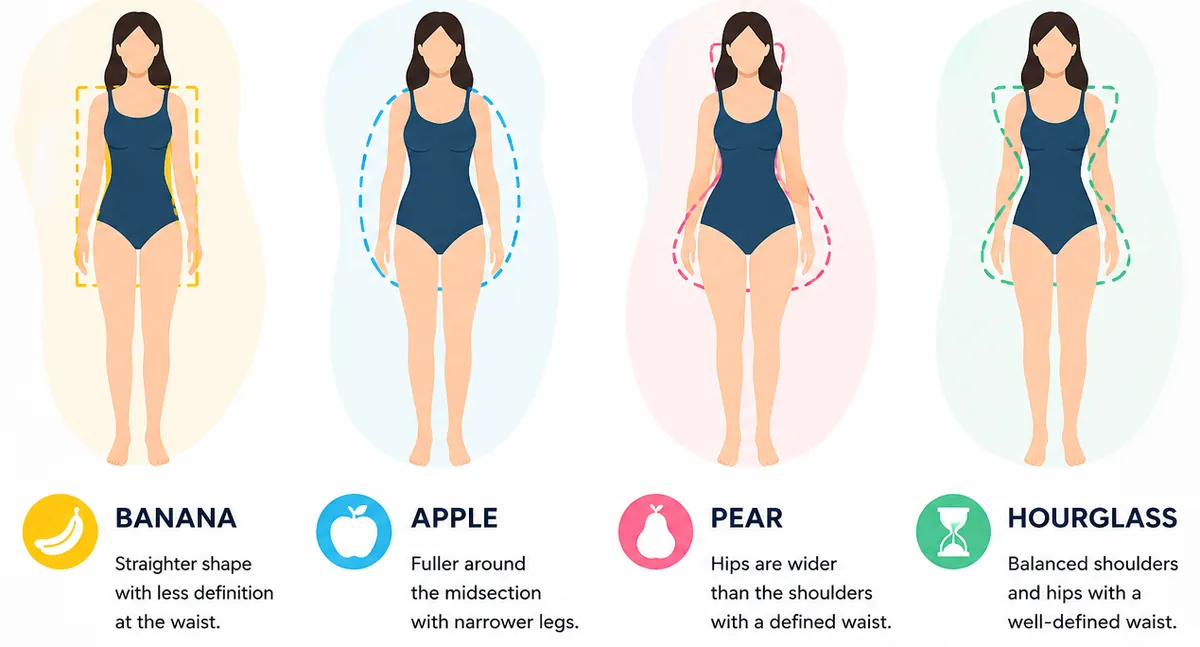
Retail and styling advice almost always uses four shapes: apple (or inverted triangle), banana (straight or rectangle), pear (spoon, bell or triangle), and hourglass. The seven-category version splits the coarser groups where garment fitting actually differs — the hourglass into three variants depending on which half is fuller, and the pear family into spoon and triangle depending on the upper hip.
A frequently cited 2005 study of more than 6,000 women at North Carolina State University found roughly 46% banana-shaped, just over 20% pear, just under 14% apple, and only about 8% hourglass. Worth holding onto: the shape presented as the default in advertising is the rarest one measured.
Waist-hip ratio, and what it actually tells you
Waist-hip ratio is waist circumference divided by hip circumference. A 30-inch waist with 40-inch hips gives 0.75. Unlike the shape category, this number does carry health information, because it reflects where fat is stored rather than how much of it there is.
Fat around the abdomen behaves differently from fat around the hips and thighs, and is more strongly associated with cardiovascular disease and type 2 diabetes. The World Health Organization treats a ratio above 0.85 in women and above 0.90 in men as indicating abdominal obesity, and this calculator flags that threshold when you cross it. Some research has found the ratio predicts cardiovascular risk better than body mass index does, particularly in older adults.
It is one signal among several, not a diagnosis. A high ratio is a reason to raise the subject with a doctor, who can look at blood pressure, blood glucose, lipids and family history alongside it. A low ratio does not rule anything out.
Using a shape to shop, without letting it shop for you
The practical value is knowing in advance where clothes made to a standard block will and will not fit you. If your hips run 6 inches wider than your bust, a dress cut for a straight figure will be tight at the hip and loose at the waist, and the fix is a size up plus a waist alteration rather than a different dress. If your waist is 10 inches narrower than both, belts and fitted waists will look tailored without alteration.
Where this goes wrong is when the categories turn into rules about what you are allowed to wear. There is a large amount of styling advice built on the premise that every body should be dressed to look like an hourglass. Treat the shape as information about garment fit, not as a prescription. The clothes are supposed to fit the person.
Where the classification breaks down
- Only four numbers. Height, torso length, shoulder width, posture and where your waist actually sits all affect how clothes hang, and none of them are inputs here.
- Hard boundaries on continuous bodies. A tenth of an inch can move you between categories. If you sit near a threshold, you are genuinely between shapes.
- Built on a specific population. The rules come from a study of US and Korean women; proportions vary across populations and the thresholds are not universal.
- Designed around female measurements. The seven-shape system was developed for womenswear fitting and is not meaningful for male body proportions.
- Shape is not health. Every category contains healthy and unhealthy people. Only the waist-hip ratio speaks to health, and only weakly on its own.
Frequently asked questions
How do I find out my body shape?
Measure your bust, waist, high hip and hip, then compare the differences. If your bust and hips are within about an inch and your waist is at least 9 inches smaller, that is an hourglass; if all three are close together, that is a rectangle. The calculator applies all seven rules for you.
What is the difference between a spoon and a triangle?
Both are wider at the hip than the bust. The spoon has a pronounced upper-hip shelf, which shows up as a high-hip to waist ratio of 1.193 or more, and a waist at least 7 inches narrower than the hips. The triangle has the width lower down and a waist less than 9 inches narrower.
What is the most common female body shape?
Rectangle, also called banana or straight. The North Carolina State University study of over 6,000 women found about 46% in that category, against roughly 8% hourglass.
Is the hourglass shape healthier than the others?
No. The categories describe proportion, not health. The waist-hip ratio shown alongside carries some health signal because it reflects where fat sits, but the shape name itself does not.
What is a healthy waist-hip ratio for a woman?
The World Health Organization treats above 0.85 in women as indicating abdominal obesity and raised risk. Below that is generally considered lower risk, though it is one measure among many and should be read alongside other indicators by a doctor.
Why did the calculator say it could not classify me?
Because some measurement combinations satisfy none of the seven rules. The system has gaps, and reporting no match is more honest than forcing you into the nearest box. Your measurements are still valid, and the waist-hip ratio is still shown.
Can I change my body shape?
Bone structure and where your body stores fat are largely set by genetics, so the underlying proportions are mostly fixed. Weight change alters the numbers but usually not the category, and the categories are not something to aim at.
Does this work for men?
No. The seven-shape system was developed for womenswear fitting using measurements taken on women, and the thresholds do not transfer. The waist-hip ratio applies to anyone, with a different WHO threshold of 0.90 for men.
This calculator is a garment-fitting tool provided for general information and is not medical advice. Body shape categories are descriptive labels from clothing research, not health assessments, and no shape is better or more desirable than another. The waist-hip ratio is one indicator among many and cannot diagnose anything; discuss any concerns with a qualified healthcare professional. If measuring your body is something you find distressing, or if thoughts about your body or eating are affecting your daily life, support is available — in the US, the National Alliance for Eating Disorders helpline is free and staffed by clinicians on 1-866-662-1235. Learn more about how we build these tools or read our privacy policy.